It always begins the same way.
A crisis at the border.
A statement from the ISPR.
A suspiciously uniform media chorus: “The nation stands united behind its defenders.”
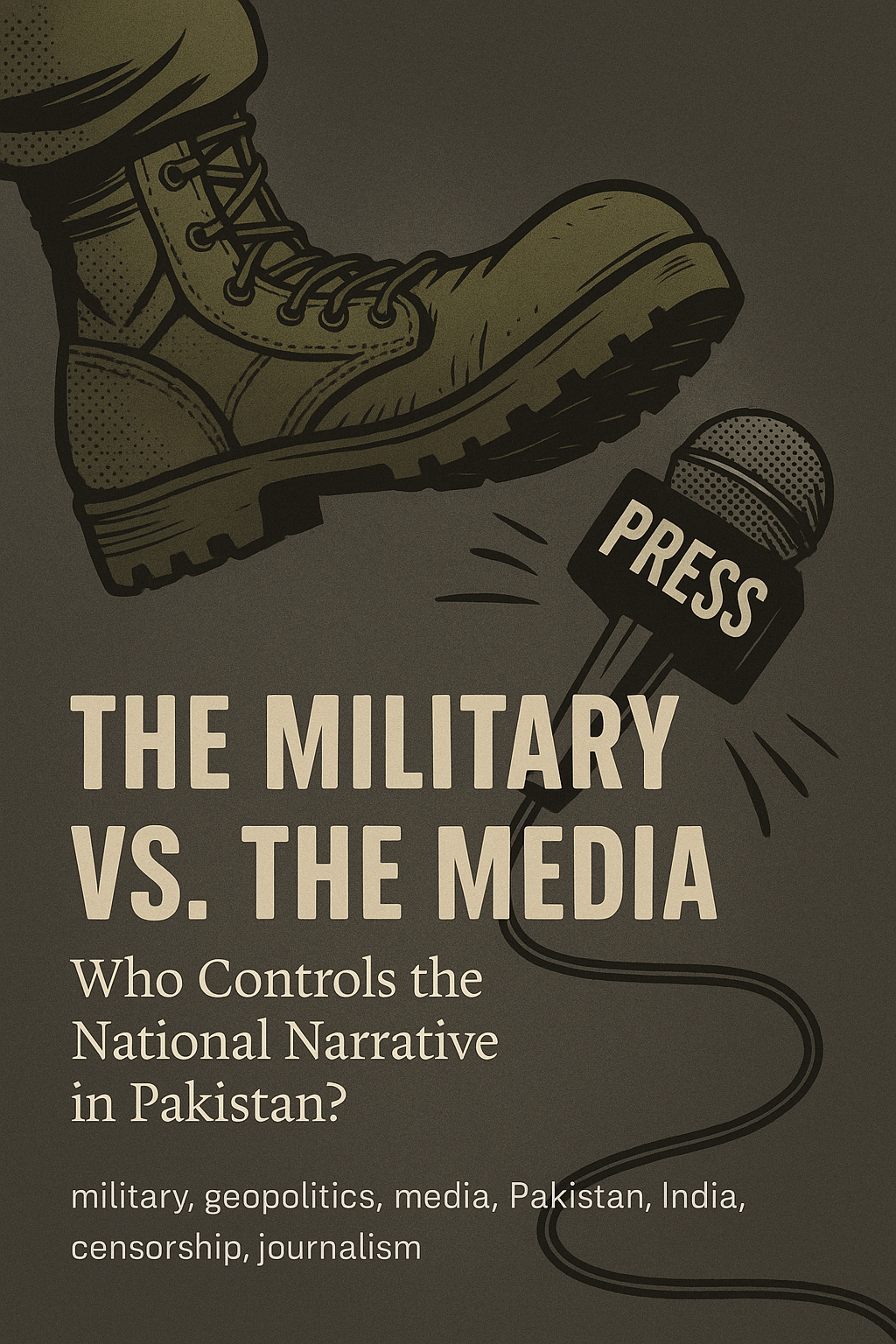
No questions. No follow-ups.
Just loyalty, volume… and silence.
In Pakistan, the battle for truth doesn’t always involve bullets.
Sometimes, it’s fought with headlines.
When the Military Becomes the Editor
Pakistan’s military doesn’t just guard the borders. It guards the narrative.
From the controlled tones of state-run PTV to the cautious phrasing of prime-time anchors, it’s no secret that Rawalpindi casts a long shadow over what the nation hears and sees—especially in moments of diplomatic tension or military action.
• During the Kargil War (1999), Pakistani media was given a sanitized version of battlefield realities.
• In the post-Balakot fallout (2019), domestic coverage largely mirrored ISPR briefings, while critical voices were drowned out.
• Following cross-border tensions in 2024’s Operation Sindhudurg, several Pakistani outlets played down naval vulnerabilities—while international outlets like Reuters and CNN told a very different story.
Control isn’t always overt.
Sometimes it’s a phone call. Sometimes it’s a license renewal.
Sometimes it’s just a reminder: “Think of national interest.”
But Pakistan Isn’t Alone
Media-military friction is not a uniquely Pakistani phenomenon.
In India, wartime narratives have increasingly blurred the line between journalism and jingoism.
Channels like Republic TV and Zee News often echo government positions, especially during standoffs with China or Pakistan. Critical military reporting exists—but is increasingly pushed to the margins.
In the U.S., the Pentagon has long shaped media access to war. From the "embedded journalists" during the Iraq invasion to the curated briefings in Afghanistan, the military has learned how to “manage the message” while projecting transparency.
In Turkey, President Erdoğan has fused civilian and military narratives, with widespread crackdowns on dissenting voices post-2016 coup attempt. The military is no longer just a guardian of secularism—it’s a partner in political control.
So what makes Pakistan different?
In most democracies, the military answers to civilian oversight. In Pakistan, the dynamic is often reversed. The military doesn't just want favorable coverage—it often writes the script.
When the Camera Is a Weapon—and a Target
Here’s what happens when media steps out of line in Pakistan:
Channels go dark: Geo, ARY, and Dawn have all faced mysterious blackouts at key political moments.
Journalists go missing: From Matiullah Jan to Saleem Shahzad, the list of abducted or killed reporters is long—and still growing.
Narratives get spun: Whenever there's a military failure, the media swiftly pivots to nationalism, distraction, or silence.
Even digital platforms aren't safe. Social media accounts critical of the military are suspended. Troll armies drown independent voices in noise and vitriol.
In this battlefield, the camera lens can become just as threatening as a missile.
Why It Matters: The Story Is a Weapon
You ever wonder why authoritarian-leaning states work so hard to control the media during war?
Because perception is power.
If the people believe they’re winning, dissent slows.
If the nation believes it’s under threat, questions disappear.
If the military appears infallible, budgets stay bloated—and coups stay justifiable.
Truth is dangerous because it destabilizes illusions.
And in Pakistan, those illusions have sustained entire regimes.
Last Word
So who really controls the national narrative?
In Pakistan, it’s not just the man with the mic.
It’s the man with the uniform standing behind him.
And until the press is free to speak—not just echo—the nation won’t truly know what’s happening at its borders… or in its own heart.
Comments
Post a Comment