Showing posts with label authoritarianism. Show all posts

Libya Is Not a Warning. It’s an Alibi for Power

 Someone always brings up Libya when power feels nervous.

Not as history.
Not as context.
But as a threat.

Behave, or you’ll end up like Libya.

It sounds like wisdom. It’s actually a shortcut. And shortcuts in geopolitics usually hide something.

Recently, that line resurfaced again, this time framed as advice to Iran, attributed to Aisha Gaddafi. Learn from Libya. Do not trust the West. Look at what happened after intervention.

The sentence travels well online because it is emotionally tidy. One villain. One lesson. One fear. But real history is never that cooperative.

Libya Didn’t Collapse Overnight

Libya did not fall apart because people suddenly demanded change, nor because they naïvely trusted foreign powers. It fell apart because the state had already been hollowed out for decades. Institutions were not institutions at all. They were extensions of one man, one family, one network of loyalty.

When NATO intervened in 2011, it did not destroy a functioning state. It shattered what little scaffolding remained. Then it left. That was the crime of intervention. But pretending everything was fine before is another kind of dishonesty.

Libya’s tragedy has two authors. Internal decay and external violence. Erasing either side turns history into propaganda.

Why Libya Is Always Invoked

Libya is useful because it is frightening.

It has become the ultimate scarecrow in the Middle East. Mention it and debate stops. Fear takes over. Alternatives collapse before they are even articulated.

That is why Libya is constantly dragged into conversations about Iran. Not because the cases are comparable, but because the image is powerful. Chaos. Militias. Endless instability.

The message is clear. Better this, whatever this is, than that.

But here’s the uncomfortable truth. Using Libya this way is not about protecting people from collapse. It is about protecting systems from accountability.

Iran Is Not Libya

Iran is not Libya in 2011. Different society. Different institutional depth. Different political culture. Different regional position.

More importantly, Iran’s core crisis is not blind trust in the West. It is the suffocating gap between state power and social legitimacy. Between rulers who speak in the language of resistance and citizens who experience governance as control.

Invoking Libya to silence Iranian demands is intellectually lazy. It replaces analysis with fear. It assumes that the only alternative to authoritarian stability is total collapse.

That assumption is convenient. And very dangerous.

When Fear Becomes Governance

Once Libya becomes the final argument, nothing else has to improve.

Corruption is excused as stability.
Repression is justified as protection.
Silence is marketed as patriotism.

Every failure is waved away with the same line. At least we are not Libya.

But a system that relies on fear of chaos to survive is already brittle. A state that treats its people as a threat rather than a foundation is not stable. It is stalled.

History shows this again and again. States do not collapse because citizens ask questions. They collapse when institutions rot and reform becomes impossible.

The Real Lesson of Libya

Libya’s lesson is not “never trust the West.” That is too simple and often self-serving.

The real lesson is this:
A state that hollows itself out in the name of control leaves nothing behind when crisis arrives.

Foreign intervention did not save Libya. It did not build it either. But Libya was already vulnerable long before the first jet crossed its skies.

Turning Libya into a warning poster for other societies does not honor its tragedy. It weaponizes it.

And when history is reduced to threats, the future stops being a choice.

Maybe that is the real danger people should be talking about.

America Is Testing the Limits of Democracy—and ICE Has Become the Stress Point

 For a long time, Americans believed that democratic collapse was something that happened elsewhere. In fragile states. In distant regions. In countries with weak institutions.


That assumption is now being tested at home.

What is unfolding across several American cities in 2026 is not a single scandal or an isolated abuse of power. It is something slower and more structural: the repurposing of state authority in a way that blurs the line between law enforcement and political pressure.

At the center of this tension is Immigration and Customs Enforcement, better known as ICE.

On paper, ICE exists to enforce immigration law. In practice, its expanded role has turned it into a symbol—both for those who believe the state must act decisively, and for those who fear that enforcement is drifting toward intimidation.

This is not yet a constitutional crisis. But it is a stress test.


From Enforcement to Atmosphere

Every country enforces its borders. That principle is not in dispute.

What is being questioned in the United States is the method, the visibility, and the political context in which enforcement is taking place.

Recent ICE operations have been unusually public. Officers often appear masked. Detentions happen in everyday spaces—parking lots, outside schools, near workplaces. Even when legal authority exists, the optics matter.

Law enforcement does not operate in a vacuum. It operates in public memory.

When enforcement becomes performative, it changes how citizens interpret power. Fear spreads faster than facts. Communities begin to self-police through silence. And distrust becomes ambient.

This is not accidental.

Political scientists have long noted that governments under pressure sometimes favor visible displays of authority. Not to solve a problem completely, but to signal control. The message is subtle: order is being maintained, and resistance carries consequences.


The Case That Changed the Tone

Public unease intensified after the January 7 shooting of Renee Nicole Good, a 37-year-old U.S. citizen who had just dropped her child at school.

According to official statements, ICE agents acted under perceived threat. But video footage, widely circulated and reviewed, raised serious questions. Renee appeared to be leaving the scene. She was unarmed. The use of lethal force appeared excessive to many observers.

What followed proved just as consequential as the incident itself.

Rather than immediately calling for an independent investigation and de-escalation, senior officials framed the event defensively. Language hardened. Responsibility blurred. Sympathy was replaced by suspicion.

That response widened the gap between institutions and the public.

It also triggered protests—first localized, then national.


Why the Protests Are About More Than Immigration

It would be a mistake to read the current demonstrations as a simple defense of undocumented immigration.

Most protesters are not demanding open borders. They are questioning how power is exercised, who is protected, and whether accountability still applies uniformly.

In cities such as New York, Chicago, Minneapolis, and Los Angeles, the slogans reflect this shift: Justice, Due Process, Accountability.

The concern is not that ICE exists. The concern is what ICE is becoming in the public imagination.

When enforcement agencies appear insulated from scrutiny, they stop being neutral instruments of law and begin to resemble political tools—whether or not that was the original intent.


A Familiar Pattern in Political History

History rarely repeats itself exactly, but it often follows recognizable patterns.

In the early 20th century, several democracies weakened not through coups, but through gradual normalization of extraordinary measures. Paramilitary visibility increased. Opposition was portrayed as disorder. Emergency rhetoric justified expanded authority.

Germany in the 1920s is one well-known example, but not the only one. Similar dynamics appeared in parts of Latin America, Eastern Europe, and Asia at different moments.

The lesson is not that America is repeating those histories wholesale. The lesson is that democratic erosion often begins while elections still exist and courts still function.

The danger lies in complacency—assuming institutions will self-correct without public pressure.


Why ICE Matters in the Bigger Picture

ICE’s role today matters because it sits at the intersection of three volatile issues: immigration, national identity, and executive power.

Its increased activity in politically polarized regions has raised questions about selective enforcement. Its internal culture, recruitment practices, and operational secrecy have drawn scrutiny from civil liberties groups.

None of this means the agency is illegitimate. But it does mean it requires stronger oversight, clearer boundaries, and transparent accountability.

Without those, enforcement risks drifting into coercion.


What Happens Next Will Matter Beyond America

The United States remains a global reference point—rightly or wrongly—for democratic norms. When its internal tensions escalate, the ripple effects are felt worldwide.

If democratic safeguards weaken in a superpower, authoritarian governments elsewhere feel emboldened. Norms erode faster. Justifications multiply.

That is why what happens in American streets today is not just an American issue.


A Moment of Choice

The most important fact is this: the system has not collapsed.

Courts still function. Elections are scheduled. Protest remains legal. Journalists still report.

That means this is not an ending. It is a moment of choice.

History shows that democracies survive not because institutions are perfect, but because citizens demand restraint when power expands too far.

The debate unfolding around ICE is, at its core, a debate about limits.

And how that debate is resolved will shape not only America’s future—but the confidence the world places in democratic governance itself.

The Mamdani Collectivism Controversy: Why Context Matters More Than Memes


When History Is Flattened Into a Meme

The Mamdani Collectivism Controversy and the Cost of Ignoring Context

The Mamdani collectivism controversy did not begin with a speech or a policy proposal. It began, as these things often do now, with a viral image.

A simple layout. Familiar historical names. Red circles for emphasis.

Joseph Stalin.
Mao Zedong.
Benito Mussolini.
And then, placed deliberately among them, Zohran Mamdani.

The single word tying them together is collectivism.

No explanation follows. None is needed. The visual insinuation does the work. The viewer is nudged toward a conclusion before context can interfere.

But once context is restored, the comparison begins to collapse.


What authoritarian collectivism actually meant

Stalin, Mao, and Mussolini were not engaging in academic debates about economic systems or social welfare. Their statements were doctrines of power.

When Stalin dismissed the individual, he was legitimising a system where dissent had no legal standing. When Mao spoke of subordinating individuals, he was justifying revolutionary coercion enforced through the state. When Mussolini declared everything to be within the state, he was defining fascism’s core principle: authority without external limits.

This was authoritarian collectivism.
It was enforced through prisons, purges, and the destruction of independent institutions.

These words were not theoretical. They were operational.


Zohran Mamdani and collectivism in a democratic context

The Zohran Mamdani collectivism debate belongs to a different political universe.

Mamdani’s comments emerge from a democratic policy argument, not a regime proclamation. When he criticises “rugged individualism,” he is referencing a long-standing ideological tradition in American political thought — one that treats markets as moral arbiters and frames social failure as personal failure.

In political theory, this critique is not radical. It is familiar.

Mamdani’s use of collectivism aligns with social democracy:
public healthcare, labour protections, housing policy, shared social insurance. These ideas are debated openly, constrained by constitutions, tested in elections, and challenged by courts and a free press.

No coercive apparatus enforces them.
No dissent is criminalised.

That distinction is not rhetorical. It is structural.


Collectivism vs individualism is not a binary of freedom and tyranny

The viral image depends on flattening meaning.

In reality, collectivism vs individualism is not a moral shortcut. It is a spectrum of political arrangements shaped by institutions.

  • Authoritarian collectivism absorbs the individual into the state.

  • Democratic collectivism pools social risk to protect individuals from economic shocks.

Both invoke the collective. Only one abolishes personal freedom.

Treating these models as interchangeable is not historical analysis. It is political propaganda.


Follow the direction of power

A useful test cuts through the noise.

Ask: where does power flow?

Under Stalin, Mao, and Mussolini, power flowed upward. It concentrated, hardened, and became immune to challenge. Institutions existed to enforce obedience.

In Mamdani’s framework, power is intended to restrain markets, not citizens. The aim is to reduce vulnerability, not eliminate dissent.

One model produces surveillance states.
The other produces safety nets.

Confusing the two erases the difference between governance and domination.


Why propaganda memes work so well

Political propaganda memes succeed because they replace explanation with implication.

It is easier to invoke dictators than to debate healthcare costs. Easier to weaponise history than to argue about housing policy. Easier to frighten than to explain.

But when historical quotes are stripped of context and recycled as warning labels, language loses precision. Disagreement becomes suspicion. Policy debate is recast as a prelude to tyranny.

That is not how democratic societies reason about their future.

Words matter.
Context matters more.

Without both, history becomes a prop — and fear fills the space where understanding should be.

The Uniform Never Ages — From Zia to Munir: How Pakistan’s Army Reinvents Itself, Crisis After Crisis


The general salutes.
The crowd cheers.
A fighter jet slices the sky.
And once again, Pakistan forgets who’s really running the show.

But behind every parade, every press briefing, and every rousing anthem lies something older and far more strategic:

Survival.

From General Zia-ul-Haq’s prayer rug to General Asim Munir’s naval pageantry, Pakistan’s military doesn’t just fight wars.
It rewrites its role in history—again and again.


Zia: The Pious General Who Became the State

Let’s start where the myth solidified.

General Muhammad Zia-ul-Haq didn’t just overthrow a civilian government in 1977. He overthrew Pakistan’s very idea of itself.

Under Zia, the Army recast its identity—from a conventional force to a moral vanguard.
He brought Islam into the barracks. Into the classrooms. Into the Constitution.
And most crucially: into the uniform.

The Pakistan Army became not just a protector of borders, but a guardian of Islamic values.
This wasn’t just ideological. It was strategic.

With democracy suspended, political parties neutered, and the press cowed, Zia needed something to legitimize his power.
Religious nationalism was that something.

It was during Zia’s reign that Pakistan’s proxy involvement in Afghanistan boomed, and anti-India rhetoric became the blood in the Army’s veins.

He didn’t just Islamize Pakistan. He militarized its faith.


Musharraf: The Modernizer in Camouflage

Fast forward to the late ’90s.

After the chaos of the 1999 Kargil War and another coup, General Pervez Musharraf entered the scene—not as a religious ideologue, but as a "savior technocrat."

His Army wasn’t holding a Quran. It was holding a laptop.

• Musharraf portrayed himself as the liberal face of a professional army.
• He gave interviews to CNN, flirted with the West, and joined the U.S. in the War on Terror.
• He promised "enlightened moderation" even while allowing the ISI to hedge its bets with the Taliban.

Musharraf’s genius wasn’t in his contradictions—it was in selling them as balance.

He made the Army look globally responsible, locally indispensable, and democratically inevitable.
He was no Zia—but he knew how to borrow just enough from the past to justify the present.


Bajwa to Munir: The Return of the Guardian Script

In the post-Musharraf years, the Army kept its head down, but its hands everywhere.

Then came General Qamar Javed Bajwa—quiet, calculating, deeply invested in optics.
His doctrine? “Bajwa Doctrine.” His slogan? “Democracy, but under guidance.”
The Army began positioning itself as the ultimate “neutral”—stepping in only to stabilize, of course.

But neutrality was short-lived.

Under General Asim Munir, we’ve seen a revival of military maximalism.
From clamping down on Imran Khan’s movement to speeches like the one at the Pakistan Navy parade, Munir has re-armed the old narrative:
Pakistan under siege. India belligerent. The Army as the last wall standing.

And while the weapons have evolved—now it’s cyber optics, maritime strategy, and hybrid warfare—the logic remains the same:

The military is the nation. And the nation must obey.


A Uniform That Always Fits the Moment

Here’s what’s fascinating:

The Pakistan Army doesn’t stay relevant by clinging to the same story.
It changes costume, tone, and message depending on the moment.

In Zia’s time: Islam and jihad.

In Musharraf’s time: Modernity and moderation.

In today’s time: Strategic deterrence, digital control, and the old enemy (India) with a new flavor.


Each version works because each crisis demands a different performance.

The Army is many things—except irrelevant.


And Still, It Stands

The beauty—and tragedy—of the Pakistan Army’s shape-shifting isn’t just in its longevity.
It’s in how seamlessly it convinces Pakistanis that every era needs it more than the last.

When institutions collapse, when courts fold, when politicians fall—there’s always the man in uniform, waiting in the wings.
Sometimes with prayer beads.
Sometimes with missiles.
Sometimes with a mic.

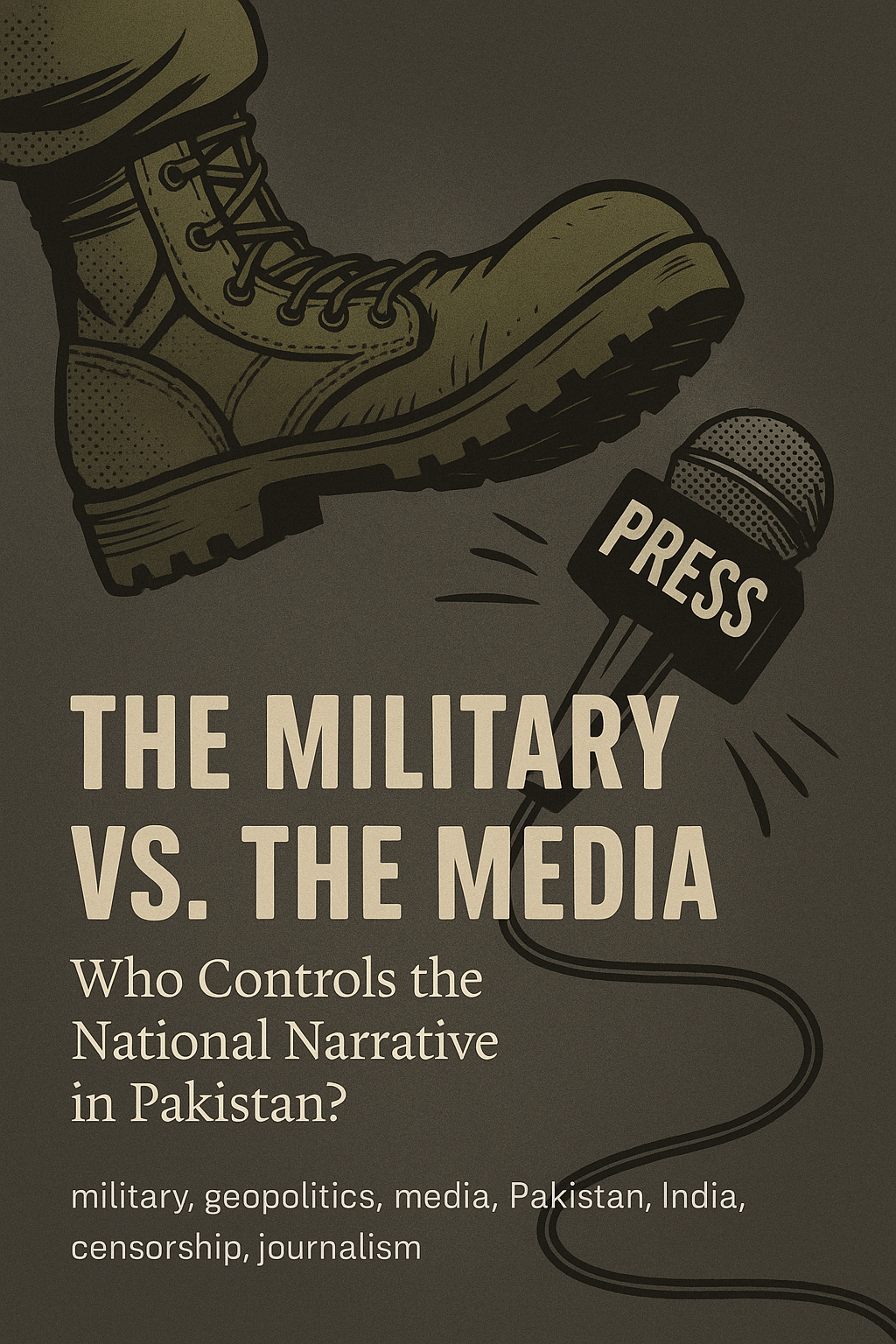
Who Tells the Nation What to Think? — The Military vs. the Media in Pakistan (and Beyond)


It always begins the same way.
A crisis at the border.
A statement from the ISPR.
A suspiciously uniform media chorus: “The nation stands united behind its defenders.”


No questions. No follow-ups.
Just loyalty, volume… and silence.

In Pakistan, the battle for truth doesn’t always involve bullets.
Sometimes, it’s fought with headlines.


When the Military Becomes the Editor

Pakistan’s military doesn’t just guard the borders. It guards the narrative.

From the controlled tones of state-run PTV to the cautious phrasing of prime-time anchors, it’s no secret that Rawalpindi casts a long shadow over what the nation hears and sees—especially in moments of diplomatic tension or military action.

• During the Kargil War (1999), Pakistani media was given a sanitized version of battlefield realities.
• In the post-Balakot fallout (2019), domestic coverage largely mirrored ISPR briefings, while critical voices were drowned out.
• Following cross-border tensions in 2024’s Operation Sindhudurg, several Pakistani outlets played down naval vulnerabilities—while international outlets like Reuters and CNN told a very different story.

Control isn’t always overt.
Sometimes it’s a phone call. Sometimes it’s a license renewal.
Sometimes it’s just a reminder: “Think of national interest.”


 But Pakistan Isn’t Alone

Media-military friction is not a uniquely Pakistani phenomenon.

In India, wartime narratives have increasingly blurred the line between journalism and jingoism.
Channels like Republic TV and Zee News often echo government positions, especially during standoffs with China or Pakistan. Critical military reporting exists—but is increasingly pushed to the margins.

In the U.S., the Pentagon has long shaped media access to war. From the "embedded journalists" during the Iraq invasion to the curated briefings in Afghanistan, the military has learned how to “manage the message” while projecting transparency.

In Turkey, President Erdoğan has fused civilian and military narratives, with widespread crackdowns on dissenting voices post-2016 coup attempt. The military is no longer just a guardian of secularism—it’s a partner in political control.

So what makes Pakistan different?

In most democracies, the military answers to civilian oversight. In Pakistan, the dynamic is often reversed. The military doesn't just want favorable coverage—it often writes the script.


 When the Camera Is a Weapon—and a Target

Here’s what happens when media steps out of line in Pakistan:

Channels go dark: Geo, ARY, and Dawn have all faced mysterious blackouts at key political moments.

Journalists go missing: From Matiullah Jan to Saleem Shahzad, the list of abducted or killed reporters is long—and still growing.

Narratives get spun: Whenever there's a military failure, the media swiftly pivots to nationalism, distraction, or silence.


Even digital platforms aren't safe. Social media accounts critical of the military are suspended. Troll armies drown independent voices in noise and vitriol.

In this battlefield, the camera lens can become just as threatening as a missile.


Why It Matters: The Story Is a Weapon

You ever wonder why authoritarian-leaning states work so hard to control the media during war?

Because perception is power.
If the people believe they’re winning, dissent slows.
If the nation believes it’s under threat, questions disappear.
If the military appears infallible, budgets stay bloated—and coups stay justifiable.

Truth is dangerous because it destabilizes illusions.
And in Pakistan, those illusions have sustained entire regimes.


Last Word

So who really controls the national narrative?

In Pakistan, it’s not just the man with the mic.
It’s the man with the uniform standing behind him.

And until the press is free to speak—not just echo—the nation won’t truly know what’s happening at its borders… or in its own heart.

Sofia Mawdudi and the Mirage of Hereditary Guilt

  I watched a viral Facebook image flicker on my phone screen in my Karachi study, showing a woman in a red sweater wearing an American and ...