Showing posts with label social justice. Show all posts

When Democracy Becomes a Slogan: Pakistan’s Crisis of Selective Freedom

 In Pakistan, democracy has become a strangely selective idea. It is spoken with passion when directed upward, toward powerful institutions, but handled with silence when it points inward, toward homes, traditions, and social authority. Over time, democratic language has turned into a posture rather than a principle. Anti-establishment rhetoric has quietly replaced a deeper commitment to freedom itself.


Living in Karachi, you encounter this contradiction daily. In chai dhabas and drawing rooms, people speak fluently about constitutional rights, missing persons, and the abuse of state power. Often, these critiques are justified. But shift the conversation to child marriage, women’s autonomy, or authority inside the home, and the tone changes. Suddenly, democracy is accused of being foreign. Law becomes intrusion. Protection is reframed as insult.

Karachi is not unique in this, but it makes the contrast visible. This is a city where political awareness is sharp, yet social coercion is normalized. The same society that demands accountability from distant institutions often resists accountability within its own moral boundaries.

That resistance exposes a central flaw in how democracy is understood.

Opposing state authoritarianism is necessary, but it is not the full measure of democratic belief. Democracy is not defined by who you oppose. It is defined by whose rights you are willing to defend, especially when doing so unsettles tradition.

Pakistan’s Constitution is clear on this point, even if public discourse often is not. Article 8 invalidates any law or custom inconsistent with fundamental rights. Article 9 guarantees the right to life and liberty, which courts have repeatedly interpreted to include dignity and autonomy. Article 14 explicitly protects human dignity and privacy. Most critically, Article 25(3) allows the state to make special provisions for the protection of women and children.

These clauses were not added as decoration. They reflect an understanding that societies do not always protect their most vulnerable members on their own. That is why constitutional democracies exist in the first place.

This legal logic has been reinforced by Pakistan’s courts. In Shehla Zia v. WAPDA, the Supreme Court expanded the meaning of the right to life beyond mere survival, linking it to quality of life and human dignity. In Suo Motu Case No. 1 of 2004 (regarding child custody and welfare), the Court reaffirmed that the welfare of the child overrides custom, tradition, and adult interest. More recently, courts have consistently held that consent, agency, and age are not negotiable concepts when children are involved.

Against this backdrop, the defense of child marriage as a form of protest or cultural resistance collapses. When laws meant to prevent harm to minors are dismissed as “attacks on faith” or “Western interference,” children are turned into political instruments. This is not dissent. It is moral evasion.

I recall a conversation years ago in Karachi, sitting in a modest living room, the ceiling fan rattling as it struggled against the heat. Someone argued, earnestly, that restricting child marriage was a cultural betrayal. The argument was fluent, even emotional. What was missing was the child herself. Not as a symbol, but as a person. Her fear, her lack of consent, her future were never mentioned. She existed only as an idea—useful for argument, invisible as a human being.

That absence tells us everything.

The debate is often framed as a choice between an overreaching state and an authentic society. This framing is dishonest. When the state fails and society refuses self-correction, it is women, children, and minorities who are left unprotected. Karachi knows this reality well. When formal law recedes, informal authority steps in. Elders decide. Honor replaces consent. Power flows downward, unchecked.

Rejecting all state intervention in the name of tradition is not neutrality. It is alignment—with those who already hold power.

Human rights cannot be defended in pieces. You cannot oppose censorship while excusing control over bodies. You cannot condemn dictatorship in uniform while defending dictatorship at home. If coercion only offends you when it is exercised against you, then your objection is not to oppression itself, but to its direction.

This is where much of Pakistan’s democratic rhetoric falters. It is angry at authority, but not committed to liberty. It resists domination selectively. Democracy becomes transactional: valid when useful, negotiable when inconvenient.

The true test of democratic belief is uncomfortable because it demands surrendering power we consider natural—over daughters, over children, over tradition—rather than only challenging power imposed from above. It asks whether freedom is a principle or a tactic.

The question, then, is not who is speaking against which institution. That is political theatre. The real question is quieter and more revealing: Who are you standing for when no one is forcing you to? The individual with agency, or the tradition that demands obedience? The child with a future, or the ideology that needs a symbol?

In Karachi, and across Pakistan, democracy will remain incomplete until it travels inward as confidently as it travels upward. Until we apply the language of rights not just to the state, but to ourselves. Until freedom is no longer selective.

Only then will democracy stop being a slogan—and start becoming a practice.

Does Islam Protect Divorced Women? Lessons from the Shah Bano Case?

 The Shah Bano case is often reduced to a single claim:

that the courts interfered with religious law.

But that framing avoids a deeper and more uncomfortable question.

Does Islam actually allow an elderly, divorced woman with children to be left without financial support?

If the answer is yes, then the issue lies within religion itself.
If the answer is no, then the problem lies in how religion has been interpreted and applied.

What Islamic Principles Say

In Islam, marriage is not merely a personal relationship. It is a contract built on responsibility.

The Qur’an places financial responsibility on men, particularly toward their children. This responsibility does not disappear with divorce.

  • A father remains obligated to provide for his children

  • Children are not the financial burden of the mother alone

  • Financial support during the waiting period (iddat) exists to prevent immediate hardship

These principles are widely acknowledged within Islamic jurisprudence.

So the question arises:
If these protections exist, why did Shah Bano need the courts to survive?

Where the Breakdown Occurred

The failure was not theological in theory but practical in application.

In the Shah Bano case, religious arguments were used not to protect a vulnerable woman, but to limit a man’s continuing responsibility. The waiting period was treated as a ceiling rather than a minimum safeguard.

The broader ethical purpose of justice was overshadowed by narrow legal interpretations.

This shift transformed religious law into a tool of convenience rather than protection.

The Silence Around Women’s Futures

Religious discussions frequently cover men’s rights in detail: divorce procedures, remarriage, authority.

Far less attention is given to what happens to women after divorce, especially older women who are no longer economically independent.

That silence is not accidental. It reflects priorities.

The Often-Ignored Question of Children

Public debates around Shah Bano focused heavily on the woman. But the most overlooked issue was the children.

In Islam:

  • Children are not exclusively the mother’s responsibility

  • A father’s obligation toward them does not end with divorce

Any interpretation that allows a father to withdraw financial responsibility from his children contradicts both ethical reasoning and religious intent.

Divorce may end a marriage, but it does not erase parenthood.

A Broader Conclusion

Islam contains principles intended to protect women from abandonment and hardship.

What failed in the Shah Bano case was not faith itself, but the selective use of faith—where legal form was prioritized over moral substance.

The case remains relevant because it raises a universal concern:
When legal systems or religious interpretations prioritize convenience over justice, the most vulnerable pay the price.

That is not a question of religion versus law.
It is a question of responsibility, fairness, and moral accountability.

The Invisible Harvest: Examining the Exploitation of Undocumented Migrants in Italy

 Imagine you are seated in a sun-drenched piazza, sipping a rich espresso while the golden Italian light dances across ancient cobblestones. It is the quintessential dream of the Mediterranean. However, just beyond the frame of your holiday photograph exists a different Italy. In this shadow world, desperate individuals chase promises that frequently dissolve into harrowing nightmares. The exploitation of undocumented migrants in Italy is not merely a headline about boats on the evening news; it is a systemic meat grinder that consumes human dignity for the sake of cheap produce. As I unpack these complexities, I must ask: how much of our comfort is built upon the suffering of those we refuse to see?


A Foundation of Policy and Paradox

The Italian migration landscape has reached a critical juncture in early 2025. While government data suggests a 30% decline in arrivals due to stringent maritime agreements, the underlying tension remains unresolved. Prime Minister Giorgia Meloni’s administration famously championed the "Albania Pact" as a definitive solution to border control. This initiative sought to offshore asylum seekers to processing centers outside the European Union. Nevertheless, the reality has been far less seamless than the rhetoric. By late 2024, Italian courts repeatedly blocked these transfers, declaring the detention of certain groups legally "dodgy" and returning them to Italian soil.

This policy is like attempting to repair a shattered hull with adhesive tape. It provides the appearance of a fix, yet the water continues to rise. While the state focuses on deterrence, over 2,200 individuals perished in the Mediterranean last year alone. When we prioritize border optics over human safety, we do not stop the flow; we simply ensure that those who arrive are more vulnerable and desperate than ever before.

The Narrative of the Shadow Economy

The true tragedy of the exploitation of undocumented migrants in Italy unfolds in the agricultural heartlands. If you find your standard workday taxing, consider the life of a laborer in the fields of Latina or Verona. Here, modern-day serfdom is the standard operating procedure. Migrants from South Asia and Africa often toil for 12 hours a day under a scorching sun for a meager 4 or 5 euros per hour. This is roughly half the legal minimum for documented workers.

Consider the harrowing case of Satnam Singh, a Sikh laborer whose death last year exposed the rot within the system. After his arm was severed by a hay baler, his employer reportedly dumped him on the road like refuse rather than seeking medical aid. He died from a lack of humanity as much as a lack of care. Such brutality is not an isolated incident. It is the logical conclusion of a system where workers are treated as disposable tools. Employers recognize that undocumented status is a silencer. If a worker complains, the threat of deportation is always lingering in the background. Is it not a profound hypocrisy that the Italian economy relies on this "invisible" labor to stock supermarket shelves while the political discourse demands "Italians first"? The agricultural sector would likely collapse without these hands, yet the system rewards their contribution with silence and abuse.

Vulnerability and the Gendered Risk

The risks escalate significantly for unaccompanied minors and women who arrive without a social safety net. For a young woman traveling from sub-Saharan Africa, the lack of a legal pathway creates a vacuum that traffickers are eager to fill. Without relatives or Italian language skills, the high costs of urban living quickly lead to desperation. These individuals become targets for "caporali"—gangmasters who skim wages and control movements through debt bondage.

Human rights organizations have highlighted how EU deals with North African nations often leave migrants exposed to violence and exploitation before they even reach European shores. We are essentially sweeping the mess under the rug, allowing it to fester in the shadows. It is a heartbreaking cycle that treats human beings as statistics rather than souls.

An Objective Analysis of a Fractured Future

Recently, Italy has introduced stricter regulations and increased police raids to combat labor abuse. The Verona bust, which freed 33 Indian farmhands from "slavery-like" conditions, demonstrates that accountability is possible. However, enforcement remains spotty in rural provinces where the law rarely reaches. Without a genuine path to legal status, the exploitation of undocumented migrants in Italy will persist as an underground economy.

The current approach feels half-hearted and contradictory. Italy faces a demographic crisis with an aging population that requires new labor, yet current policies push that labor into the hands of criminals. We must decide if we value the cheapness of our tomatoes more than the lives of those who pick them. Awareness is the first step toward dismantling this "modern serfdom," but it requires the courage to look past the sun-drenched piazza.

Do you believe Europe should focus on offshoring and borders, or is it time to prioritize labor integration and human rights?

Who’s Really Draining Germany? A Rebuttal to the Migrant-Blaming Rhetoric


“Your chancellorship will go down in German history as the greatest electoral fraud.”
That’s how the speech began. Not with data. Not with policy. With anger.

And the rest followed in kind: migrants are freeloaders. Refugees are rapists. Afghans are flown in to ruin the schools. Every second recipient of welfare is foreign. Merkel lied. Scholz is lying. Tax money is being “thrown out the window.” Germany is dying. Knife attacks. PISA scores. Islamization. Collapse.

It’s tempting to react emotionally. But what if the truth is more complicated—and less convenient for those who shout the loudest?


My daughter and son-in-law live in Germany. They pay taxes.

They pay rent. They ride the same trains, pay the same electricity bills, and navigate the same bureaucracy that frustrates everyone from Munich to Mecklenburg.

They’re not freeloading. They’re contributing—like millions of immigrants who work in hospitals, software firms, auto plants, and construction sites across Germany. And yet, when someone like them receives a child benefit, or applies for language classes, they’re portrayed as parasites?

That’s not policy critique. That’s a smear.


What’s true—and what’s political fiction?

  • "Every second recipient of citizen’s benefit is foreign."
    Technically correct, but misleading. The number includes Ukrainians and recognized refugees. As Labor Minister Hubertus Heil clarified in the Bundestag:

    “Basic security is not a gift. It is a bridge—to integration, to the labor market. That’s how we ensure both dignity and contribution.”
    Many beneficiaries are also children, elderly, or people in vocational training. Not freeloaders.

  • “Refugees get more than pensioners.”
    Not true. Pensioners receive contributions-based payments; refugees receive the minimum for subsistence. Economics Minister Robert Habeck responded to this claim:

    “No refugee in this country gets more than someone who worked 35 years in a factory. This is a populist lie, not a statistic.”

  • “Migrant crime is skyrocketing.”
    The Federal Criminal Police Office (BKA) notes an uptick in some categories involving migrants, but overall violent crime remains stable or falling. Context matters. As Interior Minister Nancy Faeser put it:

    “Yes, we must prosecute crimes regardless of who commits them. But we will not tolerate that entire groups are demonized to score cheap political points.”

  • “Naturalization is being handed out like candy.”
    Not even close. Becoming German requires years of legal residence, B1-level German, a clean record, and financial independence. In 2023, the government simplified some pathways—but it’s still one of Europe’s stricter systems.
    Chancellor Olaf Scholz defended the reforms:

    “Those who live, work, and raise children here should have the chance to belong fully. That strengthens our democracy, not weakens it.”


It’s not immigration. It’s mismanagement.

Yes, Germany has problems:

  • A housing shortage.

  • Strained schools and hospitals.

  • High inflation and energy costs.

But it’s not Afghans or Syrians who gutted affordable housing. It’s decades of underbuilding and speculation.

It’s not hijabs that broke the education system. It’s federal underfunding and lack of teacher support.

And it’s not immigrants draining the budget. In fact, a 2021 study by the IAB (Institute for Employment Research) found that refugees begin contributing net tax revenue within 6–8 years.

So who benefits from pretending otherwise?


“Dumbing down” the nation? Or lifting it up?

Let’s talk schools. Yes, PISA scores are falling—but not because of migration. OECD researchers blame digital lag, lack of teacher training, and curriculum stagnation.

Education Minister Bettina Stark-Watzinger said it clearly in May 2024:

“We must invest in all children—native-born or newly arrived. Integration isn’t the cause of our school crisis. It’s the victim of neglect.”

Meanwhile, Germany’s future workforce is shrinking. Immigrants—like my daughter and son-in-law—are part of the solution, not the problem.


Who is really leaving Germany?

The speaker complained that 200,000 professionals left Germany last year. That’s true. But again—context.

The German Chamber of Industry and Commerce (DIHK) says the main drivers are:

  • High cost of living.

  • Over-regulation.

  • Uncertain energy policy.

Immigrants didn’t cause that. In fact, many of those emigrating are themselves second-generation migrants seeking global opportunities.


Blaming the outsider never gets old. But it never solves anything.

Germany needs reform. It needs stronger controls and smarter migration policy. But it also needs truth, not panic.

My daughter and son-in-law don’t need to be defended with data. They prove their worth every tax return, every grocery bill, every sleepless night caring for their new baby.

They are Germany now.

And the louder someone screams that the country is being “invaded,” the clearer it becomes that they’re losing the argument—and the future.


So maybe it’s not the migrants who betrayed Germany.
Maybe it’s the politicians who ran out of answers—and found scapegoats instead.

We Are All Jews Here”—But Some Are More Equal Than Others


A boy in uniform salutes the Israeli flag while his grandmother, wrapped in a faded shawl from Gondar, stands behind him with tears in her eyes. He is Ethiopian. She is proud. And yet, even in that moment of belonging, something lingers. Something unsaid.

Maybe this is what integration looks like: uniforms, Hebrew fluency, and youth protests sparked by police bullets.

Maybe that’s the tragedy too.

You ever wonder how a country born from persecution can build its own ladders of exclusion?


When Justice Wears a Kippah but Looks Away

Let’s talk about success—because it’s always the counterpoint, isn’t it?

“But look,” someone says, “that Ethiopian girl just became a judge.”

True. But what of the dozens of Ethiopian teenagers locked away for petty crimes at rates three times higher than their peers?

And sure, Mizrahi music plays in Tel Aviv clubs. But whose accent do newscasters still mimic when they want to sound "uncultured"?

Israel's founders dreamed of ingathering exiles—Jews of all colors and customs. But not all exiles were welcomed equally. Ashkenazim (European Jews) became the architects. Mizrahim (Jews from Arab lands) were assigned the guest rooms. Ethiopians? Sometimes, they were made to knock twice.

In the 1990s, Israel’s national blood bank was found to have been quietly discarding blood donations from Ethiopians—for fear of HIV. No press release. No apology. Just a silent verdict that echoed: "Your blood isn't good enough."


The Mizrahi Majority That Still Feels Peripheral

Now here’s a twist: Mizrahim aren’t a minority in Israel. They’re the majority.

And still, they earn 36% less on average than Ashkenazim. A Mizrahi resume gets fewer callbacks. And the university halls remain disproportionately Ashkenazi.

How did a people who carried Arabic lullabies, Persian poems, and North African cuisine into Israel end up being told to drop their “Arab habits”?

Ben Gurion once dismissed Moroccan Jews as “primitive.” Policy followed prejudice. Arabic was discouraged, French was fine. Middle Eastern customs were exoticized, then erased.

Traditional Yemeni dance became “Israeli folk dance.” Not Yemeni. Not Arab. Just… assimilated.


 Echoes from Karachi, Dhaka, and Kabul

If you're South Asian, this all sounds familiar.

Ahmadis in Pakistan. Chakma tribes in Bangladesh. Hazaras in Afghanistan. Every post-colonial state inherits fault lines—and often deepens them.

Israel privileged its European Jews just as our own post-Partition elites favored Urdu-speaking migrants or those with colonial-era diplomas. It's not about religion. It's about who speaks the “right” language, wears the “right” clothes, eats the “right” food.

It’s why an Ethiopian Israeli might distance himself from African asylum seekers. Why a Mizrahi youth might lean harder into Israeli nationalism—just to prove he’s not “Arab.”

Because when the state says, “We’re all Jews here,” it doesn’t always say it equally.


 Beyond the ‘Apartheid’ Frame

Here’s where it gets tricky. Is this apartheid?

Not in the South African sense. Ethiopian and Mizrahi Jews are citizens. They vote. They serve in the army. Some rise to high office.

But scratch beneath the surface and you’ll find softer walls—less visible, but just as real. Cultural exclusion. Bureaucratic cold shoulders. Ashkenazi dominance in media, academia, and the rabbinate.

That’s not apartheid. But it is discrimination. And it demands a reckoning.


Seeds of Change, But Will They Grow?

Some signs offer hope.

Ethiopian officers now command army units. Mizrahi chefs are reclaiming pride in their culinary heritage. Activists are louder. Protests more visible.

But systems are stubborn. A state that questions the Judaism of Ethiopian elders or marginalizes Mizrahi prayer traditions isn't just being bureaucratic. It’s sending a message: there’s a hierarchy here. You’re in it. But not on top.


Final Thought: The Danger of Simple Stories

We want our stories to be clean. Israel is either a refuge or a colonizer. Mizrahim are either fully Israeli or forever outsiders. Ethiopians are either victims or success stories.

But life isn’t binary. It's layered. And acknowledging injustice doesn’t mean denying belonging.

Maybe the better question isn’t: “Is Israel racist?”
Maybe it’s: “How can any society born of trauma avoid reproducing it?”

South Asians should ask the same. We've done it too.

Because in the end, building a just society isn’t about purity. It’s about courage—especially the courage to see your own reflection in the eyes of those you once othered.

Then again, maybe silence says enough.

“She Was Just Three: The Girls Who Disappear While We Scroll”

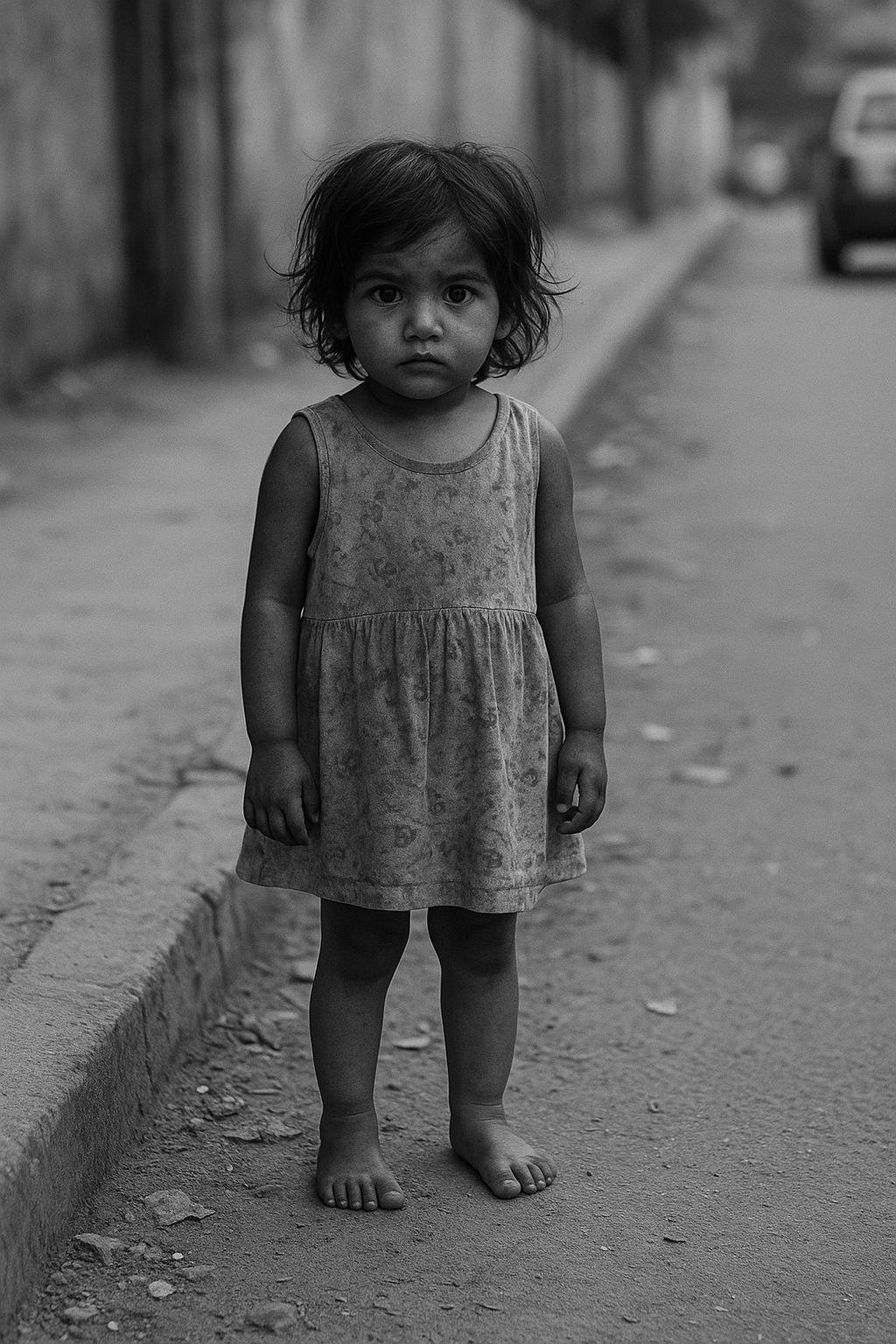
A dusty footpath. Sindh Government Hospital. Midday heat curling the air.


She couldn’t have been more than three.

Alone.
Wobbling along the pavement like it belonged to her.

No hand to hold. No adult in sight.

For a second I thought—maybe someone’s just behind her. A mother buying medicine? A distracted father paying the rickshaw fare?

But no.
She just kept walking.
Unbothered. Or maybe too used to being invisible.

And my heart sank like it always does in this city.
Because in Karachi, a small girl alone isn’t a harmless accident.
It’s a blinking red light.


No One Is Coming

Negligence. That’s the polite word.
But what do you call it when a child is left vulnerable in the middle of a place where even grown men stay alert?

We hear about abuse. Abductions. Disappearances.
But before all that—there is neglect.

The kind that starts quietly:

A child left alone outside a pharmacy.

A baby girl sleeping on a bench in a government ward while her mother begs for injections.

A four-year-old waiting for a father who may not even return.


Here’s what I noticed: these are not always poor parents. Sometimes it’s exhaustion. Sometimes drugs. Sometimes just a heartbreaking loss of instinct. But almost always, it’s girls who bear the brunt.

There’s something in our society that tells us: a little girl doesn’t matter that much. She’ll manage. She’s not the heir anyway.

And then one day, she disappears.


What the Numbers Refuse to Forget

You don’t see many news stories about missing little girls in Pakistan.
But dig into the reports, and you’ll find:

In 2023, the NGO Sahil reported 3,242 cases of child abuse.

Of those, 1,112 were abductions.

And girls made up nearly 60% of them.


Children under the age of 10 were involved in more than 20% of these cases.

Karachi police and Madadgar helpline say over 700 children go missing from the city every year.

Most from low-income areas.

Many snatched near hospitals, bus stops, schools, or while playing in alleys.


The Edhi Foundation confirms: baby girls are abandoned far more than boys.

Some left at their cradles.

Others found in drains.


And these are only the reported cases.

How many vanish without a single phone call to the police?
How many mothers are too ashamed—or too scared—to even admit their child is gone?


A Country of Ghost Girls

You ever wonder why it’s always a boy’s name on the missing poster?
You ever ask why a family would look for a son for years, but never report their daughter missing?

I met a nurse at JPMC once. She told me about a toddler who’d been sleeping in the ward for two days.
“She says she’s waiting for ammi,” the nurse said. “But no one’s come back.”

That was months ago.
They put her in a shelter.

They named her Noor.

I still wonder if her mother forgot her. Or just… let her go.


No Hero Ending Here

I wish I had something noble to say—that I followed the girl, found her mother, lectured someone. I didn’t. I just watched. Prayed under my breath. And walked on, half-sick with guilt.

But maybe that’s the real tragedy.
Not just that these girls are left behind—
but that we’ve all gotten used to it.

Women Experience Diabetes Differently Than Men

  I remember sitting in the waiting room at Civil Hospital Karachi three years ago, watching an exhausted woman in a black chador argue with...