Showing posts with label censorship. Show all posts

The Silence Over Sami Hamdi: When Free Speech Becomes a Crime

 A British journalist disappears in America — and London says nothing.


Where is the UK government? One of their citizens, a journalist, has been detained in the United States — without charge, without transparency, and without a word from Westminster. Sami Hamdi, a respected British journalist known for his sharp criticism of Israeli policies and vocal defense of Palestinian rights, has vanished into the machinery of U.S. immigration enforcement.

The facts are chilling. Hamdi had been in the country for several days. He was about to take a domestic flight from San Francisco to Florida when plainclothes ICE agents approached him. They told him his visa had been revoked. He offered to leave voluntarily — to board a flight back to London. But they refused. Instead, they took him away in a black van. No charges, no due process. Just silence.

What do you call that?
Some call it an arrest. Others — an abduction.

A user named @asielmundo said it best: “If his visa was revoked, the authorities had the responsibility to deport him to his homeland or the country he came from. Otherwise, what they did was an abduction, violating his human rights.”

Even more striking is how ordinary people are reading this — not as a bureaucratic mishap but as a political message. @abdirahmaanmohamed1582 called it “Trump’s gestapo serving Israel’s agenda.” Another wrote, “This shows how paranoid the Zionists are getting. This will only raise Sami Hamdi’s voice even higher.”

Because here’s the truth: Hamdi wasn’t targeted for breaking any law. He was targeted for breaking silence.

He’s become an influential voice — one of the few in Western media willing to name the ongoing genocide in Gaza and to challenge the narratives that sanitize it. That kind of honesty has consequences now.

And yet the silence from the UK government is almost louder than the act itself. No press conference. No statement. No demand for his release. A British citizen is effectively kidnapped on American soil, and the same Britain that once boasted of Magna Carta shrugs.

Meanwhile, people around the world are responding not just with outrage but with faith. “May Allah protect him and return him to England to his family,” wrote one supporter. “He is a noble man. His case is just horrible.” Another added, “Let’s take a moment to appreciate this woman’s steadfastness — his wife, whose loyalty keeps him strong. Alhamdulillah for the amazing women of this Ummah.”

It’s not just about Sami anymore. It’s about what his detention reveals — a fear spreading through Western democracies that free speech has limits when it comes to Israel.

A reader named @evilmonkey3684 captured the unease perfectly: “Straight up murder in Venezuela, and now detaining foreign nationals and members of the free press without charge — the U.S. has become a rogue criminal state.”

Imagine if they abducted people for speaking at events about American–Jewish relations. Would the silence still be this thick?

Sami Hamdi’s detention isn’t only a legal or diplomatic issue. It’s a moral one. It tells us what happens when truth becomes contraband — and conscience becomes a crime.

The U.S. must release him immediately. And Britain must remember that its duty doesn’t end at the edge of the Atlantic.

Because if a journalist can be taken for speaking his mind, then no passport, no profession, and no principle is safe anymore.

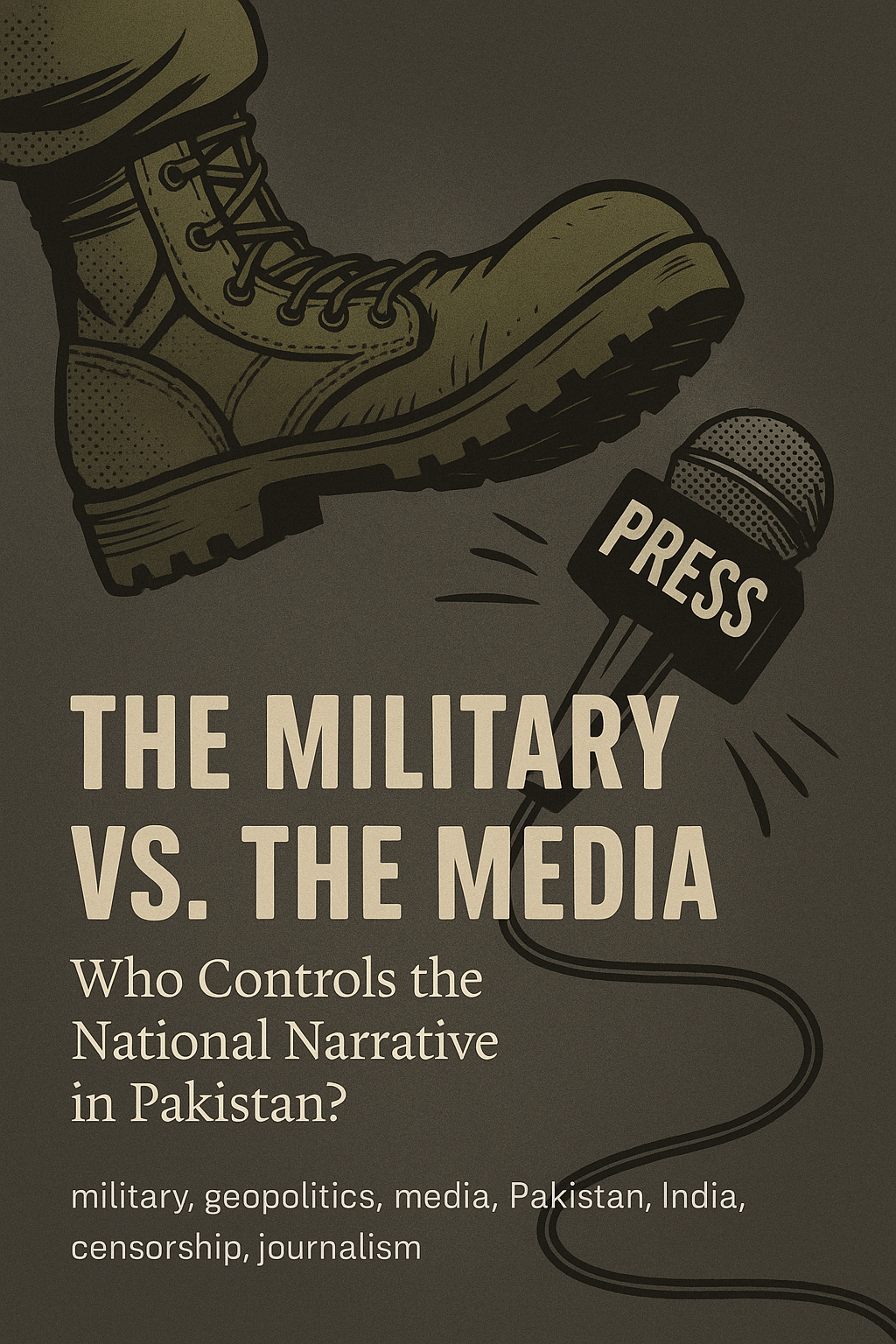
Who Tells the Nation What to Think? — The Military vs. the Media in Pakistan (and Beyond)


It always begins the same way.
A crisis at the border.
A statement from the ISPR.
A suspiciously uniform media chorus: “The nation stands united behind its defenders.”


No questions. No follow-ups.
Just loyalty, volume… and silence.

In Pakistan, the battle for truth doesn’t always involve bullets.
Sometimes, it’s fought with headlines.


When the Military Becomes the Editor

Pakistan’s military doesn’t just guard the borders. It guards the narrative.

From the controlled tones of state-run PTV to the cautious phrasing of prime-time anchors, it’s no secret that Rawalpindi casts a long shadow over what the nation hears and sees—especially in moments of diplomatic tension or military action.

• During the Kargil War (1999), Pakistani media was given a sanitized version of battlefield realities.
• In the post-Balakot fallout (2019), domestic coverage largely mirrored ISPR briefings, while critical voices were drowned out.
• Following cross-border tensions in 2024’s Operation Sindhudurg, several Pakistani outlets played down naval vulnerabilities—while international outlets like Reuters and CNN told a very different story.

Control isn’t always overt.
Sometimes it’s a phone call. Sometimes it’s a license renewal.
Sometimes it’s just a reminder: “Think of national interest.”


 But Pakistan Isn’t Alone

Media-military friction is not a uniquely Pakistani phenomenon.

In India, wartime narratives have increasingly blurred the line between journalism and jingoism.
Channels like Republic TV and Zee News often echo government positions, especially during standoffs with China or Pakistan. Critical military reporting exists—but is increasingly pushed to the margins.

In the U.S., the Pentagon has long shaped media access to war. From the "embedded journalists" during the Iraq invasion to the curated briefings in Afghanistan, the military has learned how to “manage the message” while projecting transparency.

In Turkey, President Erdoğan has fused civilian and military narratives, with widespread crackdowns on dissenting voices post-2016 coup attempt. The military is no longer just a guardian of secularism—it’s a partner in political control.

So what makes Pakistan different?

In most democracies, the military answers to civilian oversight. In Pakistan, the dynamic is often reversed. The military doesn't just want favorable coverage—it often writes the script.


 When the Camera Is a Weapon—and a Target

Here’s what happens when media steps out of line in Pakistan:

Channels go dark: Geo, ARY, and Dawn have all faced mysterious blackouts at key political moments.

Journalists go missing: From Matiullah Jan to Saleem Shahzad, the list of abducted or killed reporters is long—and still growing.

Narratives get spun: Whenever there's a military failure, the media swiftly pivots to nationalism, distraction, or silence.


Even digital platforms aren't safe. Social media accounts critical of the military are suspended. Troll armies drown independent voices in noise and vitriol.

In this battlefield, the camera lens can become just as threatening as a missile.


Why It Matters: The Story Is a Weapon

You ever wonder why authoritarian-leaning states work so hard to control the media during war?

Because perception is power.
If the people believe they’re winning, dissent slows.
If the nation believes it’s under threat, questions disappear.
If the military appears infallible, budgets stay bloated—and coups stay justifiable.

Truth is dangerous because it destabilizes illusions.
And in Pakistan, those illusions have sustained entire regimes.


Last Word

So who really controls the national narrative?

In Pakistan, it’s not just the man with the mic.
It’s the man with the uniform standing behind him.

And until the press is free to speak—not just echo—the nation won’t truly know what’s happening at its borders… or in its own heart.

Sofia Mawdudi and the Mirage of Hereditary Guilt

  I watched a viral Facebook image flicker on my phone screen in my Karachi study, showing a woman in a red sweater wearing an American and ...